
At the heart of any successful enterprise is a Plan. Planning surrounds us everywhere. We plan our household chores, we plan our family budget, we plan vacations, we plan sports and stick to a training plan, we plan work, shopping, etc., all in order to achieve our goals and desired results.
Planning is the optimal allocation of resources to achieve the set goals
This series of articles will talk about marketing planning and a one-size-fits-all approach to it. In this detailed article we will consider goal setting
Every business owner should realize that his main task is to increase the value of his company. All processes and activities should be built around this.
In a world of high speed, high turnover and a huge flow of data, the key role in achieving goals is played by Planning and clear adherence to the Plan of all participants in business processes, it is a kind of road map leading the company to success.
Promotion of the product and the company itself, their positioning and differentiation is the most important task of any business, covering a wide range of questions that need answers and systematization.
Thus we need a Marketing Plan and the development of strategies, tactics of action and tracking of indicators.
Let’s define the concept of marketing planning.
Marketing planning– development of a sequence for promoting the company on the market and its development. This is work with the product and the demand for it, the choice of tools to increase sales.
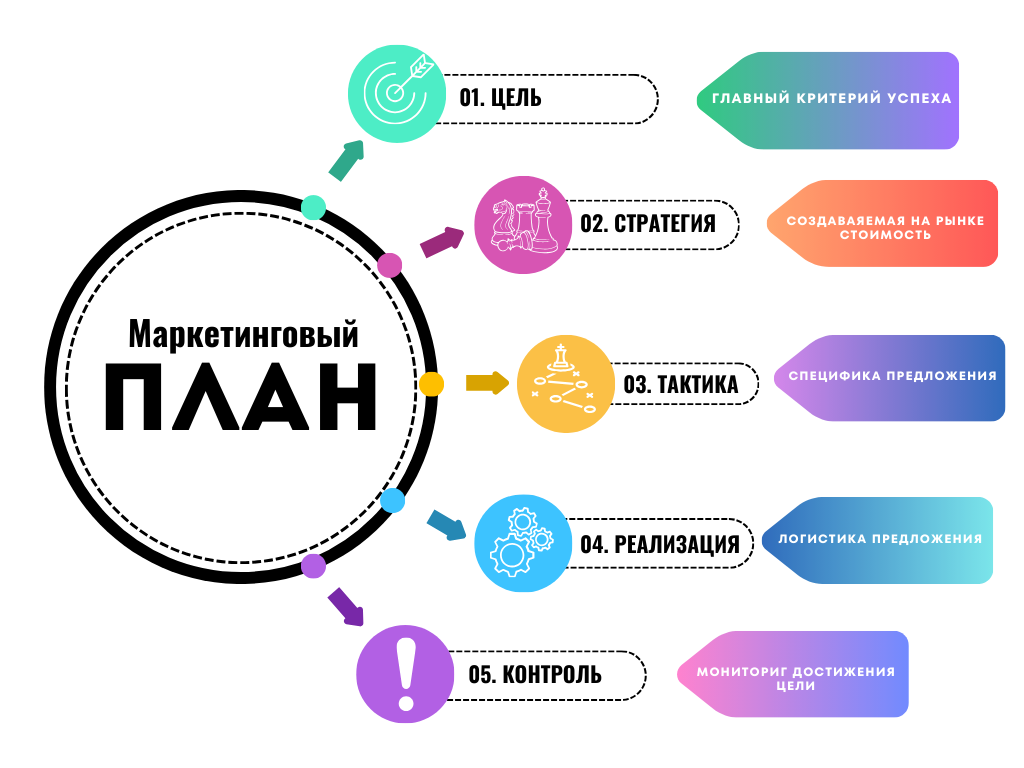
Developing a plan is defined by 5 steps – Setting a Goal, Developing a Strategy, Developing a Tactic, Creating an Implementation Plan and Defining a Set of Benchmarks.
The G-STIC model incorporates five of these components and acts as the core of marketing planning and analysis.
The components of the G-STIC approach are as follows:
Goal – describes the criterion for the ultimate success of the Company.
Strategy – provides the foundation of the business model by defining its target market and value proposition.
Tactics (Tactic) – ways of implementing strategy.
Implementation – the processes involved in preparing a product for sale.
Control – Tracking and measuring the company’s performance over time.
Marketing Planning Scheme
Next, let’s take a closer look at goal setting.
OBJECTIVE
When you have an understanding of where you need to go, it becomes easier to create a route. In our model, the Goal is the basis on which the whole structure is built, so you need to be able to set goals based on a number of criteria. Namely, the goal should be specific, measurable, achievable, relevant and time-bound (according to the SMART principle). It guides action, helps to focus on what is important and serves as a reference point for decision-making. Depending on their direction, goals can bemonetary и strategic.
- Monetary targets are defined by quantitative indicators such as net profit, revenue, return on investment, etc. Often, it is these indicators that are used as the main ones to assess performance.
- Strategic objectivesare formulated in terms that have a strategic meaning. Among the most common ones are increasing sales volume, expanding presence, brand recognition, enhancing corporate culture, improving the quality and qualifications of personnel.
Companies and entrepreneurs seeking to gain and maintain a strong market position for as long as possible are trying to think more broadly and are increasingly looking beyond revenue and profit to the social, ethical, environmental and legal implications of their activities. The concept that the essence of business is “triple bottom line” – people, planet and profit has become widespread.
For example, many companies emphasize their involvement in environmental care and protection, as well as participation in charity events in their advertising and promotions. All this increases the level of trust and perception in the eyes of potential customers and partners.
It is also imperative to determine quantitative and temporal benchmarks
- Quantitative measures are set in specific chilos or percentages, take 30% market share, achieve sales of one million units of product, reduce staff attrition by 40%
- Time indicators set a period of time to achieve a certain quantity or quality indicator. The timeline is a key point that influences the choice of strategy to achieve the goal, the number of people involved and the costs involved.
Thus realizing the goal requires answering three questions:
- What she’s trying to accomplish? (Goal direction)
- How much? (Quantitative indicator)
- When? (Temporal indicator)
Example: You can aim to generate a net profit (target benchmark), of $50 million (quantitative benchmark) in 3 years (time benchmark).
A clear definition of the Objective, setting realistic quantitative and time settings allow for “fine-tuning” of the promotion strategy and tactics.